Bristol vs the world

A travel (and sometimes fashion) blog about exploring Bristol and the rest of the world, one post at a time.

Category: City break

Food Friday: Cheap eats in Singapore

As I mentioned in my last post, Singapore isn’t exactly a budget travel destination. The prices aren’t quite London standards, but they certainly don’t tally with what you expect from the majority of South-east Asia.

But that doesn’t mean you can’t eat well on the cheap. Instead of heading to a restaurant, seek out the city’s hawker centres – huge food courts selling Singapore’s version of street food (actual on-street food carts don’t really exist here – these hawker centres are Singapore’s way of regulating them and, I imagine, helping to keep their deserved squeaky clean reputation). Not only are they well-priced – you’re looking at less than £10 for a meal for two with drinks – but they’re also an unmissable experience in themselves. Buzzing and busy, they’re where the locals meet and you could find yourself sharing a table with a huge range of interesting people. In fact, it was thanks to the Chinese family sat next to us in one food court that I discovered lime juice (so. good.). Even if you end up with a table to yourself, these are perfect places for people watching.

In fact, all factors combined, I’d probably go as far say that the hawker centre experiences were some of my highlights of our time in Singapore.

Top tip for hawker centres? As everyone will tell you, the longer the line at the stand, the better the food. So don’t be tempted by convenience (you’re on holiday, what’s the rush?!) and instead make time to queue up – it’ll probably be worth it!

We tried out five different food courts – here are my thoughts. (NB. I’m a rubbish blogger and forgot to write down the name of the stalls we tried, so I’ve concentrated more on the atmosphere and experience than food itself. TripAdvisor contains some great reviews with stall recommendations, however, as do blogs – or you could just do as we did and gamble!)

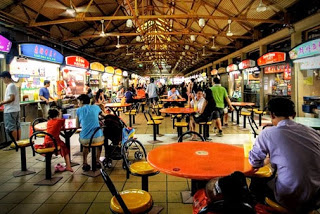
Maxwell Road Hawker Centre, Chinatown
Although not as busy as some of the more central centres, Maxwell Road is still quite well-known on the tourist circuit. Due to a jet-lag induced late morning nap on our arrival in Singapore, we visited relatively late for lunch so had no problems with queues or finding a table, but I’ve read reviews that suggest there can be. Not the most atmospheric of the food courts we visited, but this was probably because it wasn’t as busy. But the food is excellent – we both had (very generous portions of) seafood rice, which I’d highly recommend if I could remember the name of the stand… At this point we hadn’t discovered the joys of the fresh drinks on offer, so were boring and went for canned drinks so I can’t offer advice on them.

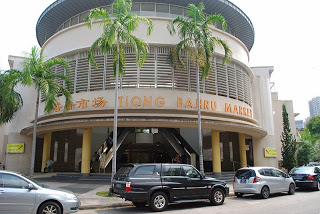

Tiong Bahru Market
Making the most of our unlimited SMRT journey tickets, I convinced John that we should make a trip to the Tiong Bahru neighbourhood so I could visit Books Actually (deserving of a post in itself). And OK, I also quite wanted to see the shop that only sells glass-less glasses (the area is like the Singapore Shoreditch). As we were in the area, we decided to stop in a Tiong Bahru Hawker Centre for dinner, which I’d read good things about; many local bloggers claim to make special journeys here from far-off (or as far-off as you can get in Singapore) districts. This certainly appeared to be the case on our visit; even mid-week, we noticed a lot of people arriving and leaving by taxi. It certainly felt more ‘local’ and less touristy than the other centres we visited, though the same could be said for the Tiong Bahru area in general.
Tiong Bahru hawker centre is also, in its way, an historical destination. Although, as mentioned above, Singapore doesn’t really have ‘street food’ any more, it used to be a big problem for the city. Tiong Bahru market – originally Seng Poh – was the first of these regulated centres, opening in 1950. With just one floor, the centre was quite different to the one you visit today. Renovated between 2004 and 2006, it is now a multi-story experience that can seat up to 1,400 diners at any one time. To put it into perspective, the UK’s biggest restaurant (Bristol’s Za Za Bazaar) seats up to 1,000.

Despite its size, Tiong Bahru hawker centre wasn’t as intimidating an experience as you might expect. Possibly because this was the quietest of the centres we visited – a lot of stalls were closed in the evening so if there’s a particular stand you want to try then I’d recommend a lunchtime visit. However the food we tried – chilli tofu for me and a rice dish for John – was probably some of the most flavour-full we had in Singapore.

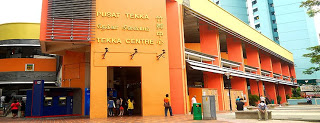


Tekka Centre Food Court, Little India
Brightly-coloured buildings on hot, dusty roads: Little India feels like a world away from the rest of Singapore and is a must-visit. While you’re here, be sure to visit the local food court, which is close to the SMRT station exit. Although not quite fair to judge (it was the only centre we visited for lunch rush-hour, which appears to be the busiest time for the centres), this was also definitely the liveliest of those we ate at. Finding a table wasn’t easy, but we did manage to do so! But many others appeared to get around the problem by eating at the stands they had just bought from.

It was also possibly the least well-kept of the centres we visited, feeling slightly dustier and older. If it had been the first we visited I can imagine having felt quite intimidated by the whole experience. But it’s worth sticking out – the food was tasty, cheap and offered a different selection to the others we visited; unsuprisingly, there were more curries on offer than elsewhere.

It’s perhaps worth noting that the traditional Indian way of eating many of these meals is with your hands. However there’s plenty of stalls that provide cutlery (we were boring and ate at one of these, and the food was still perfectly good). If you do decide to go for the hands-on experience then there are taps at the exit – so get stuck in!


Makansutra Glutton’s Bay
Located in near the touristy harbour, Glutton’s Bay understandably isn’t the most authentic of hawker centre experiences. It’s just that bit too clean and shiny and ordered. That isn’t to say it’s not worth a visit though – of the centres we visited at night, it was probably the livliest, the location is ideal, and we enjoyed eating in the (properly) open air.
We didn’t try a main meal here so you’ll have to trust TripAdvisor for that, but we just had to try the Durian fruit desserts. It definitely tastes better than it smells! We also shared a huge coconut water – well, it has to be done.
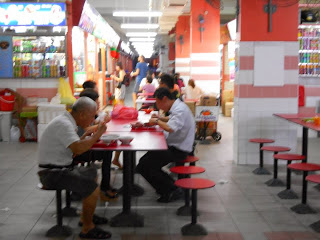
Glutton’s may not be the ‘real deal’ like some of the others, and it’s a little more expensive, but if you’re looking for food in the bay area then you could probably do a lot worse.Chinatown Food Centre
This food centre is huge. As with Tiong Bahru, the ground floor is dedicated to wet market stalls. Head upstairs and you’re confronted with a labyrinth of stands offering starters, mains, desserts and drinks. This is where I was introduced to lime juice by a family sat next to us – and it was probably the best lime juice of the whole trip (believe me, I tried quite a few of them…). The deep-fried prawn balls with chilli sauce were also pretty tasty.

As with Tiong Bahru, a lot of the stands were closed in the evening. However it was still full of families, friends and lone locals enjoying the food. Despite it being busy, the atmosphere was just that bit more relaxed that at the Tekka Centre without being too quiet (which Tiong Bahru was on the verge of being). That, combined with nabbing a table by the edge which allowed for people watching on the streets below, probably made this my favourite of the centres we visited.

Photography Credits
Maxwell Road Hawker Center (exterior): Etour Singapore; Maxwell Road Hawker Centre (interior): Your Singapore; Tiong Bahru (exterior): Go Asia @ About.com; Tekka Centre (interior): Gogobot; Tekka Centre (exterior): Singapore.com. All images should link through to original page. All other images are my own, please credit if using.

Belem, Lisbon

Today’s post focuses on Belem, an area located about 6km west of the city centre – an excellent excuse to hop on one of the gorgeous little trams for a ride. You need to get route 15, and I recommend picking it up from either the Praca Comércio or Praca Figueira – we first attempted to get on at Cais Sodre but it was completely full by that point!

Belem is most famous for its Jeronimos monastery and for having, allegedly, the best Pasteis de Nata in the city at Pasteis de Bélem. But there is much more to this beautiful – and quite calming – area of Lisbon. It’s definitely worth at least a half day of your time, and ideally a day. Just make sure that day’s not a Monday!

Jeronimos Monastery
Most people venture to Belem to visit the impressive monastery, a UNESCO World Heritage site. Its magnificence commands your attention, the building quite striking in both size and details in the Gothic architecture. It’s undeniably one of the most impressive buildings I’ve seen, religious or otherwise.

The tombs of many important Portuguese figures can be seen her, arguably most famously Vasco Da Gama, one of the most successful Portuguese explorers in the Age of Discoveries. In fact, the monastery is built on the site where he and his crew spent their last night in Portugal before leaving on their voyage to India.

Some parts of the monastery can be seen for free, but unlimited access will cost you €6. It’s open from 10 – 5, hours extending until 6 in summer. Closed Mondays.


Torre de Belem
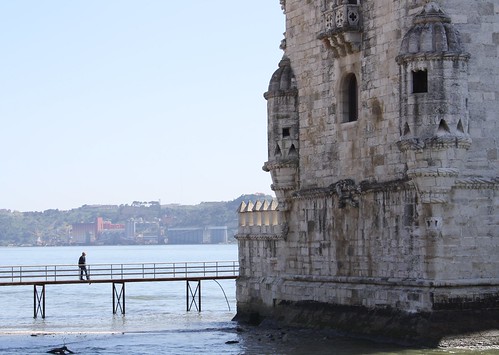
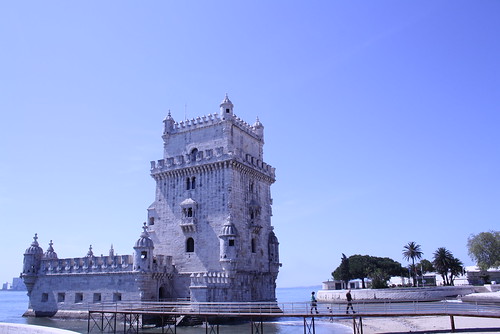
Dating from the 16th Century, the tower, like the monastery, is a UNESCO world heritage site. It was intended built both to be a defence system for and ‘ceremonial gateway’ to Lisbon. Today it serves as a monument to Portugal’s Age of Discoveries.

You can enjoy the building’s outside for free (which is what we did), but if you want to explore it more thoroughly it will cost you €4 (unless you have a Lisbon Card – then it’s free!). It’s open from 10am – 5pm, or until 6.30 in summer. Closed Mondays.

Museo Berardo
Discussed in more detail here, the Museo Berardo is a must-visit modern art museum. And it’s free!

Discoveries Monument
Built to commemorate the 500th anniversary of the death of Prince Henry the Navigator, the monument is situated on the edge of the Tagus river. It took us a while to work out what it was depicting, but it turns out those featured are notable Portuguese figures: poets, explorers, cartographers and more. We’d probably have found this out quicker if we’d known there was an exhibition space inside the monument! (There’s also a lift that offers visitors views over Lisbon.)

I particularly liked the floor mosaic infront of the monument that depicted the world and routes Portuguese explorers once took. Though so does everyone else, meaning getting a decent photo op isn’t so easy!

The exhibition space below the monument is open 10-6. No prizes for guessing the day it’s closed! (Mondays…)

The Docks
Walking to Belem Tower, you will pass some pretty docks. Perfect if you like boat porn, or just want to stop for a drink.

Pasteis de Belem
Based on those we tried during our time in Lisbon, this place really does do the best Pasteis de Nata in the city. You can read more about it here. A must-visit in Belem.

Other Attractions
Belem is home to a whole host of other museums and gardens, from the Coaches museum – a collection of royal coaches – to tropical gardens. You can find a whole list on the excellent Go Lisbon website.

Priceless Lisbon

Museu Colecca Berardo, Bélem. Photo Credit: Wikitravel

Lisbon is a great city for those travelling on a budget. Food and drink is affordable and much of the experience of the city is in discovering its many miradouros, listening to the strains of fado in the backstreets of the Alfama and getting lost in the the Bairro Alto.

And, even better, many of the cultural sites that would come at a price in many other European cities are free. Here are my three favourite priceless cultural discoveries during our time in Lisbon. This said, with only three days to explore we couldn’t cover even a tiny percentage of what was on offer, so I know I’ll have missed some great sites here. If you have any recommendations, please leave them in the comments. (NB. I will be covering the majority of Belém attractions such as the monastry in a separate post. Promise!)

Wine bottle tree, Museu Colecca Berardo. Photo Credit: Fat Pig in the Market 

Museu Coleccao Berardo, Belém
Open 7 days a week, 10am – 7pm (last entrance: 6.30pm)

This modern art museum is home to the collection of billionaire José Berardo. It features both permanent and temporary exhibits by new contemporary artists and renowned names such as Warhol, Picasso and Hockney. My favourite exhibit was Mappa Mundi, a temporary collection featuring artworks inspired by geographical maps, from collages to more political pieces.

There’s plenty here to keep contemporary art lovers entertained for hours. However even if you think that’s not your thing, it’s still worth paying the museum a visit if you’re in the area. After all, it being free of charge you can’t really go wrong. And it’s got really good air conditioning.

MUDE Museum, Lisbon. Photo Credit: Archdaily

Mude: Lisbon Design & Fashion Museum
Free of charge
Open Tuesdays – Sundays, 10am – 6pm (8pm in summer)

If our B&B host hadn’t recommended it, we would have walked straight past the Fashion & Design Museum. It’s not that it’s hard to find – with a huge sign outside of its central location it’s arguably harder to miss – but we just wouldn’t have considered paying it a visit. In fact, even then the only reason we did go in was because we were walking past and had some time to spare.

Actually, the Museum is worth planning into your trip, if only to catch a glimpse of the warehouse-style building in which it is housed, complete with exposed plaster and concrete. Its contents are pretty interesting too. Arranged by decades, they take you on a journey through the history of fashion and design by designers such as Vivienne Westwood, Yves St Laurent and Phillipe Starck. The decades are accompanied by a brief overview of history during the period, contextualising the designs of the time. , 50’s, 60’s and 70’s music plays softly in the background, growing louder as you approach those decades.

Fascinating and informative and full of lovely pieces to lust over, this museum is definitely worth a visit, especially if you’re into vintage looks or design and fashion in general.

Roman Ruins, Lisbon. Photo Credit: Polewn

Núcleo Arquelógico da Rua dos Correeiros
Rua dos Correeiros, no 9, Baixa
Very limited hours, visit the website for more details

I’ll be honestI can only really half recommend this attraction. We did go in to the museum section, featuring a number of artefacts. But, unless you’re an archaeologist or ancient historian, this small space is unlikely to hold your attention for long, although the woman working there when we visited was extremely knowledgeable and definitely worth talking to.

However, what I really want to recommend is the Roman site – a critoportico – which lies under this space, offering an insight in Lisbon life before an earthquake destroyed much of the city in 1755. The bank offers occasional tours of this area, some of which are conducted in English. We left it to late to enquire about when the next tour would be (unfortunately we had to be on a bus to the airport at the same time), so I can’t recommend it first-hand. However it’s definitely something I’ll make an effort to to try and arrange if I ever find myself back in Lisbon. Learn from my mistakes and investigate early on in your trip if you’re interested.

Ode to Lisbon

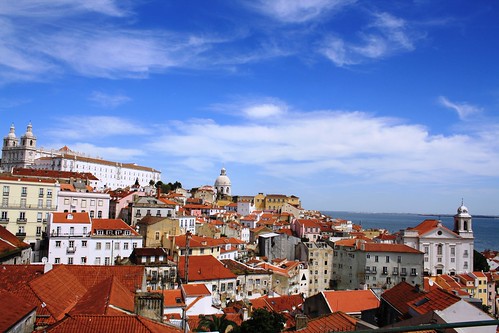
View over the Alfama district, Lisbon

I bet you know someone like it. Someone so comfortable in their own skin that it doesn’t matter what they wear or believe. They liked knitting before it was cool and can throw a mean sprinkler on the dance floor (in fact, their moves often resemble Neil’s in The Inbetweeners Movie, but they make it look so good you want to join in). They don’t crave popularity or seek attention – they’re actually pretty grounded. But there’s just something about them – about their quiet confidence, their good nature, their refreshing view of the world – that draws you in.

At the seafront, Lisbon: people and trees share a seat

When it comes to Western European cities, Lisbon is the equivalent of that person. It’s not many people’s first choice for a place to visit though. It’s not as hip or historical as Berlin or Amsterdam, as renowned for its culture and romance as Paris, as fast-paced and multi-faced as London. But Lisbon doesn’t care what you think. It doesn’t need you to think of it as beautiful or historical or party central. For a city built on seven hills, it’s incredibly laid back. And for that reason, it’s more exciting and relaxing and intoxicating than any other European city I’ve visited.

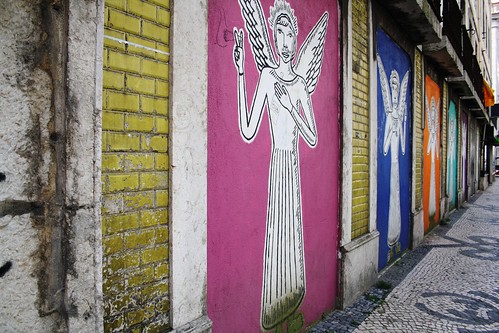
Graffiti/wall art and pavement tiles near central Lisbon
Library wall art

Lisbon’s not needing to conform is immediately apparent in its appearance. It is not typically beautiful. It doesn’t have an equivalent to Barcelona’s Gaudi architecture, it’s not as elegant as Paris, it isn’t as picture-perfect pretty as Bruges. But there is something about it that is undeniably attractive. It features ‘wall art’ that may be graffiti but might not be. It has cobbled streets and narrow backstreets and traditional yellow trams. Blue and turquoise and yellow tiles (azulejos) adorn walls and doors and streets; it doesn’t matter that they’re sometimes chipped. And then there’s the viewpoints, or miradouros. Looking out over the sea, or the city, or both, each offers a different perspective and every one takes your breath away. They’re best enjoyed with a glass of sangria of beer from the kiosks selling food and drink you will often find at these spots (it’ll be well deserved once you’ve trekked up the steep hills). Or, even better, from the (usually cheaper) newsagent down the road.

View from the Miradouro de Sao Pedro de Alcantara


Also, the city’s cultural sights might not be as renowned as the Berlin Wall, the Louvre or the Sagrada Familia, but there is still lots on offer.&nbsp I’ll discuss specific attractions in more detail in another post, so for now I’ll just use the old cliché: Lisbon has something for everyone, from Design Museums to Bélem’s monastry to the modern attractions of the Parque das Nacaoes. What’s more, many of the museums here are free, making this a perfect city break for those on a budget.

Mahjong bar, Bairro de Alto. Photo Credit: What Katie Does

But the best experiences in Lisbon are often those you just
happen upon. Although hilly, the majority of the city is quite small and so easily walkable for most people (there are trams on hand however for those with mobility issues, or just tired feet). I’m always an advocate of exploring by foot if you can, and in Lisbon this is truer than ever. Not only does is walking the best way to explore the crooked backstreets, but it also enables you to soak in the this city. So for me, Lisbon is the smell of sardines barbecuing in the Alfama. It’s watching older Lisboetas challenge one another at chess in the afternoon sun at the Jardim de Principe Real and drinking sangria with the backdrop of the ocean and the soundtrack of locals playing guitar in the Placa de Santa Catarina. It’s meandering through the streets of the Bairro Alto as they fill with high-spirited drinkers, before entering a bar to find its lights are modelled on pak-choi and the standard bar snack offering is popcorn. It’s eating warm pasteis de nata (custard tarts) in a park in Belém and licking cinnamon from my fingers.

Famous Pasteis de Nata in Bélem. Add cinnamon and eat hot.

Lisbon is hardly undiscovered. Tourists aren’t rare and, as in most cities, there are areas in the centre that feel designated for them, such as the street lined with restaurants featuring men clamouring for your custom stood
outside or, for different reasons, the majority of Bélem. After coming second in Lonely Planet’s ‘must-visit cities of 2012’ pole – beaten only by Reyjavik – it is only going to grow in popularity. Nonetheless, it still feels
like you’re able an insight into the heart of local life in the city, much more easily than in any other cenral European capital. It just seems much more accessible and welcoming to visitors in that way. And regardless of how popular it becomes, I think Lisbon’s the sort of place that will be able to retain that charm.

Placa de Santa Catarina during one of its quieter periods

Perhaps this is because Lisbon is small, making it easy to unintentionally stumble upon the less touristy areas. But it could also be due to the Lisboetas. They’re friendly, they’re unpretentious, they’re happy. They
all seem exude the spirit of those aforementioned people who are just quite happy to be them, just
living their life how they want to do so. And with a city like Lisbon to live it in, who can
blame them.